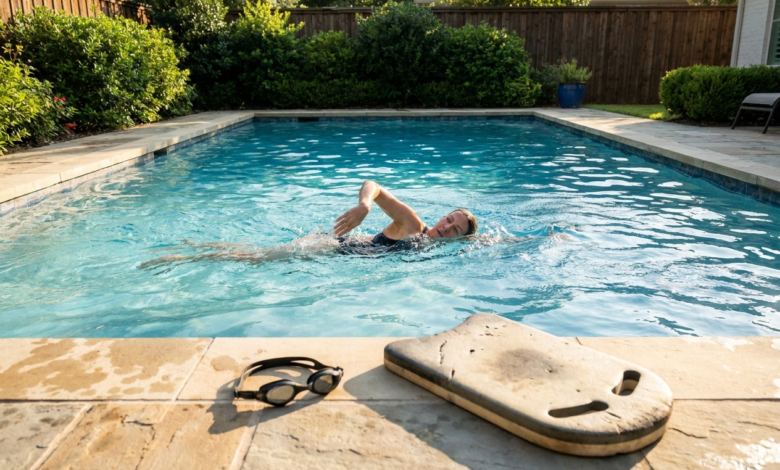
A home pool can be a great place to practice freestyle. You do not need to be a competitive swimmer. You do not need a large training facility. You only need a clear plan and a pool space that lets you repeat simple movements.
Freestyle looks easy from the outside. But good freestyle has many small parts. Your body position, breathing, kick, arm entry, pull, and timing all work together. If one part feels wrong, the whole stroke can feel harder.
The good news is that home practice can help. A backyard pool gives you privacy. It also lets you slow down. You can work on one skill at a time without lane pressure or crowded water.
The key is not to swim fast every time. The key is to practice with purpose.
Start With Body Position
Good freestyle begins with body position. Your body should stay long and balanced in the water. Your head should not lift too high. Your hips should not sink too low.
Many beginners look forward too much. This makes the head rise. When the head rises, the legs often drop. Then swimming becomes harder.
Try to look slightly down and forward. Keep the neck relaxed. Let the water support your body. Think of your body as one long line from head to toes.
A simple drill is the streamline float. Push off gently from the wall. Keep both arms forward. Keep your face in the water. Float as long as you can with a light kick. Do not rush. This helps you feel balance before you add the full stroke.
Keep Your Breathing Calm
Breathing is one of the hardest parts of freestyle. Many swimmers lift the head too much. Others hold their breath too long. This can make the stroke tense.
Try to breathe out slowly while your face is in the water. Then turn your head to the side to inhale. Do not lift the head forward. One goggle can stay in the water as you breathe. This helps keep your body level.
Practice breathing near the wall first. Hold the pool edge. Put your face in the water. Exhale. Turn your head to the side and inhale. Repeat this slowly.
Once this feels easy, add gentle kicking. Then add short swims. Keep the breath smooth. Do not worry about speed.
Practice Arm Entry
A clean arm entry can make freestyle feel much smoother. Your hand should enter the water in front of your shoulder. It should not cross too far toward the center. It should also not slap the water.
Think about reaching forward with control. Your fingertips enter first. Then the hand and forearm follow. The movement should feel quiet.
A good drill is single-arm freestyle. Keep one arm forward while the other arm swims. This helps you feel where the hand enters and how the body rotates. Switch sides after a few repeats.
In a short home pool, do this drill slowly. Focus on control. A few good strokes are better than many rushed strokes.
Improve the Catch
The catch is the part of the stroke where your hand and forearm begin to hold the water. This is where you start to move your body forward.
Many swimmers press down instead of pulling back. This can make the body lift and then sink. A better catch feels like you are anchoring the hand in the water and moving your body past it.
Try this simple feeling. Stand in chest-deep water. Place one arm forward under the surface. Bend the elbow slightly. Press the forearm and palm back toward your hip. Feel the water against your whole forearm, not just your hand.
Then try it while swimming slowly. Do not rush the pull. Keep the elbow higher than the hand during the first part of the catch.
Use a Light and Steady Kick
A freestyle kick should help your body stay balanced. It should not feel like hard splashing. For many casual swimmers, a relaxed kick is better than a powerful kick.
Kick from the hips. Keep the knees soft. The feet should move up and down in a small range. If your knees bend too much, the kick can create drag.
Use a kickboard for short sets. Hold the board in front and kick slowly. Keep your face relaxed. If your legs get tired quickly, reduce the effort. The goal is control, not force.
You can also kick without a board. Keep your arms forward in streamline. This helps connect the kick to body position.
Add Body Rotation
Freestyle is not flat. Your body should rotate slightly from side to side. This helps your arm recover over the water. It also makes breathing easier.
The rotation should come from the body, not just the head. When your right arm pulls, your body rolls slightly to the right. When your left arm pulls, your body rolls slightly to the left.
A side-kick drill can help. Kick on one side with one arm forward and the other arm resting by your side. Keep your face in the water. Turn to breathe when needed. This drill helps you feel balance on each side.
Do not over-rotate. You should not roll so far that you lose control. Keep the movement smooth and small.
Make a Small Pool Work Better
A short backyard pool can make freestyle practice harder. You may reach the wall after only a few strokes. This can break your rhythm. It can also make it hard to repeat a drill for long enough.
One way to solve this is to train by time instead of distance. Swim for 30 seconds, rest, then repeat. You can also practice one skill for each short length.
Some swimmers use resistance or a current to stay in place. A setup such as iGarden Swim Jet X AIR may appear in home pool training discussions because it can help swimmers hold a steady freestyle rhythm in a compact pool. This can be useful when the main goal is technique practice, not long-distance lap counting.
The point is simple. You do not need a perfect lap pool to improve only a swim jet. You need enough space to move safely and repeat good habits.
Try Short Technique Sets
A home pool is ideal for short practice sets. Keep them simple. Choose one focus for each set.
For example, start with five minutes of easy swimming. Then practice breathing for five short repeats. Rest after each repeat. Next, practice arm entry for five repeats. Then do a few relaxed full-stroke swims.
Another simple session can look like this:
Warm up with easy movement. Do three short streamline floats. Do four short swims with calm breathing. Do four short swims focused on quiet hand entry. Finish with two minutes of easy swimming.
This may not sound like much. But if you repeat it often, your stroke can improve.
Use Video if Possible
Video can help you see what you cannot feel. Ask someone to record a short clip from the side of the pool. You do not need a long video. A few seconds can show a lot.
Look at your head position. Check if your legs sink. Watch your hand entry. See if your body rotates. Do not judge yourself too harshly. Use the video to choose one thing to improve.
Do not try to fix everything at once. Pick one issue. Practice it for a week. Then check again.
Avoid Common Freestyle Mistakes
Many swimmers make the same mistakes. They lift the head to breathe. They cross the arm over the center line. They kick too hard. They pull too fast. They hold their breath.
These mistakes can make swimming feel tiring. They can also slow progress.
The fix is usually to slow down. Swim easier. Take more rest. Focus on one part of the stroke. Good technique often feels calm before it feels fast.
Build a Routine You Can Repeat
The best practice plan is the one you can keep doing. You do not need long sessions. Two or three short practices each week can help.
Try to swim at the same time of day. Keep your goggles and towel near the pool. Choose a simple warm-up. Pick one drill. End with easy swimming.
A home pool gives you a chance to practice often. That is a big advantage. You can build skill little by little.
Freestyle improves through repetition. Each calm breath, clean hand entry, and balanced kick matters. With a smart routine, even a small home pool can become a useful place to improve your stroke.