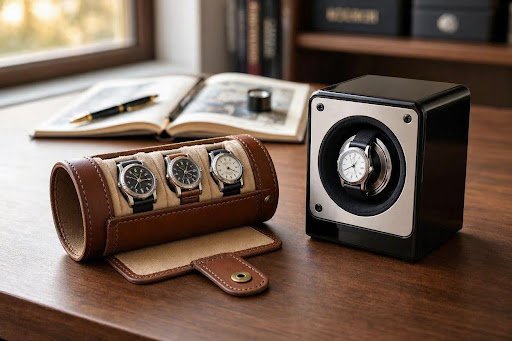
If you’ve just bought your second or third watch, you’ve probably asked yourself this question already. You store your watches somewhere, but you’re not sure if a simple case is enough, or if you need something more active.
Here’s the short answer. A watch roll protects and organises watches you’re not wearing right now. A watch winder keeps automatic watches running when they’re sitting idle. They solve two different problems, and most collectors eventually need both.
Let’s break down exactly when you need each one, and why the difference matters more than it might seem.
What Is a Watch Roll, Exactly?
A watch roll is a soft, padded case that holds one or more watches in individual compartments, usually made from leather, suede, or a similar fabric. You roll it up (hence the name) and it protects your watches from scratches, dust, and knocks while they’re stored or travelling.
There’s no moving parts, no batteries, nothing to charge. It’s pure protection and organisation.
Watch rolls come in different sizes, from single-watch travel pouches to larger rolls that hold six or more pieces. Some are built with a firmer structure to protect the watch face from pressure, while others are designed to be flexible and pack down small for a suitcase.
For anyone building a collection of dress watches, quartz pieces, or vintage timepieces that don’t need winding, a roll is genuinely all you need. If you’re weighing up different styles and sizes, it’s worth taking a look at how the explore ladies watch rolls options are laid out, since the compartment design varies a lot between brands and price points.
What Is a Watch Winder, and Why Does It Exist?
A watch winder is a motorised box that rotates an automatic watch on your wrist’s behalf, mimicking the natural movement it would get from being worn. This keeps the mainspring wound so the watch continues running, keeping accurate time, and doesn’t need resetting every time you pick it up.
This only matters for one type of watch: automatics (also called self-winding mechanical watches). These movements have no battery and no manual winding crown that you use daily. Instead, a rotor inside the case spins with the natural motion of your wrist, which winds the mainspring and powers the watch.
The problem is simple. When you take an automatic watch off and leave it sitting in a drawer, the mainspring gradually unwinds. Depending on the movement, most automatics have a power reserve somewhere between 38 and 80 hours. Once that reserve runs out, the watch stops.
That’s not damaging to the watch. But it is inconvenient, especially for complicated pieces. A watch with a perpetual calendar or moon phase complication can take real effort to reset correctly after it stops, sometimes requiring a trip to a watchmaker if the date mechanism is fiddly. A simple three-hand automatic is far less hassle to restart, but it still means resetting the time and date every single time you wear it.
The Core Difference: Protection vs Function
Here’s the way to think about it clearly.
A watch roll is passive. It protects. It organises. It travels well. It does nothing to the watch’s internal mechanism.
A watch winder is active. It keeps a specific type of movement running continuously, so the watch is always ready to wear, correctly set, and never needs manual restarting.
Neither one is “better” in general terms. They’re built for different jobs, and the right choice depends entirely on what’s in your collection.
If Your Collection Is Mostly Quartz or Manual-Wind Watches
You don’t need a winder at all. Quartz watches run on batteries and don’t lose power reserve. Manual-wind watches need daily winding by hand regardless of whether they’re worn, so a winder offers no benefit there either.
In this case, a good roll or a lined watch box is the right investment. Focus on padding quality, compartment fit, and protection from humidity and light if you’re storing anything with a leather strap.
If You Own One or Two Automatics You Wear Regularly
If you’re wearing your automatics often enough that the power reserve never fully depletes, you probably don’t need a winder either. Most people who wear the same watch several times a week keep it sufficiently wound just by wearing it.
A roll still makes sense here, particularly for travel, since it protects the watch and keeps straps from tangling or scratching against other pieces.
If You Have Automatics You Wear Occasionally
This is where winders earn their keep. If you rotate through a collection and only wear a particular automatic once every week or two, it will almost certainly stop between wears. Coming back to a stopped watch means resetting the time (and date, and day, and moon phase, depending on the complications) every single time.
A winder solves this by keeping the watch fully wound and accurate, so it’s ready the moment you pick it up.
What to Look for in a Watch Winder
Not all winders are built the same, and the differences actually matter for the health of your watch.
Turns per day (TPD) and rotation direction. Every automatic movement has a manufacturer-specified TPD requirement and preferred rotation direction (clockwise, counter-clockwise, or bi-directional). Using a winder with the wrong settings won’t damage the watch immediately, but it can under-wind or over-stress the mainspring over time. Good winders let you adjust both settings, and it’s worth checking your watch’s specific requirements before buying.
Motor quality. Cheap winders use jerky, low-quality motors that can put uneven strain on the movement over months of continuous use. A well-engineered motor runs smoothly and quietly.
Build and cushioning. The watch pillow or cushion should hold the watch securely without pressure on the case or crystal.
If you’re comparing options, it helps to look at how established brands differ in motor quality, TPD settings, and construction. Aevitas has put together a breakdown of the quality best watch winder brands range, which is a useful starting point if you’re trying to figure out what separates a genuinely good winder from an overpriced box with a motor in it.
Do You Need Both a Roll and a Winder?
For most serious collectors, yes, eventually.
A common setup looks like this: automatics that get worn regularly rotate through winders at home, keeping them accurate and ready. Everything else, including quartz pieces, manual-winds, and automatics not currently in rotation, gets stored in a roll or lined box.
Rolls also solve a problem winders can’t: travel. You’re not packing a winder in your carry-on. When you’re flying somewhere for a few days and taking two or three watches, a roll keeps them protected and organised without adding bulk or needing a power source.
This is one of the areas where a roll is genuinely non-negotiable, even if you own winders for home storage. Straps rubbing against each other in a suitcase pocket is one of the most common (and easily avoided) ways watches pick up unnecessary wear.
Storage Conditions That Affect Both
Regardless of which one you choose, a few environmental factors affect watches over time:
- Humidity can damage leather straps and, in extreme cases, affect movement lubrication. Keep watches away from bathrooms or damp storage areas.
- Direct sunlight fades dials and can degrade certain strap materials, particularly leather and some synthetic materials.
- Magnetic fields from speakers, phone chargers, and some electronics can affect the accuracy of mechanical movements. Keep watch storage away from these where possible.
A well-made roll or winder helps with the first two by keeping watches enclosed and protected. Magnetism is worth being mindful of regardless of storage method.
Getting Started
If you’re building out your collection storage from scratch, it’s worth browsing what’s available before deciding. The Aevitas UK store carries both rolls and winders across a range of sizes and price points, so you can match the setup to exactly what’s in your collection rather than buying one of everything and hoping it fits.
For a deeper technical look at how automatic movements actually function, including the mainspring and rotor mechanism referenced earlier, the Automatic watch overview on Wikipedia is a solid, accessible reference.
Final Thoughts
The roll-versus-winder question isn’t really an either/or decision once you look at what each one actually does. A roll protects and organises. A winder keeps automatics wound and ready. Most collections, once they grow past a piece or two, end up needing both.
Start with what solves your immediate problem. If you’re travelling with watches or need better protection in storage, get a roll first. If you’ve got an automatic that keeps stopping and needing resetting, a winder will save you the hassle every time you go to wear it. Either way, matching the tool to the specific watches you own, rather than buying based on price alone, is what actually protects your collection long-term.
FAQs
Do quartz watches need a watch winder? No. Quartz watches run on a battery and don’t have a mainspring that depletes when not worn. A winder provides no benefit for quartz movements.
Will a watch winder damage my automatic watch? Not if it’s set up correctly. Using the correct turns-per-day and rotation direction for your specific watch model prevents unnecessary wear. Using the wrong settings consistently, over a long period, is the main risk, so check your watch’s specifications before setting up a winder.
How long can an automatic watch sit before it stops? It depends on the movement’s power reserve, which is typically between 38 and 80 hours for most modern automatics. Some watches with extended power reserves can run for a week or more without being worn or wound.
Can I store multiple watches in one watch roll? Yes. Watch rolls come in various sizes, from single-watch pouches up to rolls holding six or more watches, each with its own individual compartment to prevent scratching or tangling.
Is a watch box better than a watch roll for storage? Both work well for storage, but rolls are more practical for travel since they’re compact and flexible. Watch boxes are generally better for permanent home display and storage, especially if you want visibility of the whole collection at once.