I. What is an Industrial Bus?
As industrial automation advances, the importance of industrial bus technology has become increasingly prominent. As a core technology in the industrial sector, it serves as the critical backbone for achieving high-efficiency communication and seamless data exchange between devices.
An Industrial Bus is a collection of common signal lines used for information transmission and communication between modules. Under the precise control of a master device, it establishes a stable and efficient information transmission path between the transmitter and the receiver.
Based on installation location, industrial buses are categorized into three types to suit different communication scenarios:
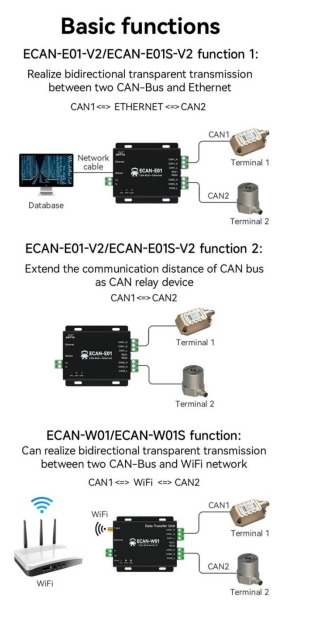
- External Bus: Common examples include RS-232, RS-485, USB, and CAN bus. These are primarily used for communication between systems and external devices or between independent systems.
- Internal Bus: Common examples include I2C, SPI, and HT (HyperTransport), adapted for signal transmission between functional modules within a single piece of equipment.
- On-chip Bus: Examples include Data Bus, Control Bus, and Address Bus. These are the core foundation for communication between components inside a microchip.
II. Core Characteristics of Industrial Buses
Industrial buses must adapt to complex on-site environments. Their core characteristics determine the rationality of the selection and are key to ensuring stable system operation:
- Real-time Performance: Many buses offer low latency and high bandwidth to meet strict timing requirements in production, preventing transmission lags from affecting efficiency.
- Reliability: To counter electromagnetic interference (EMI) and equipment failure, high-quality industrial buses possess strong anti-interference and fault-tolerance capabilities. Some feature auto-detection and self-healing functions.
- Scalability: They support the flexible integration of multiple devices, allowing for the easy addition of slave nodes as production scales without requiring a complete system overhaul.
- Interoperability: Leading bus standards are compatible with equipment from different manufacturers, enabling cross-brand communication and reducing integration friction.
- Transmission Performance: This includes transmission rate, distance, and data payload capacity. Performance varies significantly across bus types to match specific industrial scenarios.
III. Detailed Breakdown of Common Industrial Buses
1.CAN Bus
CAN (Controller Area Network) is an ISO-standardized serial communication protocol originally developed by Bosch in the 1980s. Initially designed for automotive data exchange, it is now a staple in industrial automation. As a multi-master bus, it supports twisted pair, coaxial cable, or fiber optics. It offers bit rates up to 1 Mbps and excels in harsh environments.
2.EtherCAT
EtherCAT (Ethernet for Control Automation Technology) is a high-performance Industrial Ethernet protocol designed by Beckhoff Automation in 2003. Its unique “Processing on the Fly” technology allows data to be processed as it passes through a node. Each slave device reads its data and inserts new data into the frame in real-time, virtually eliminating transmission bottlenecks and ensuring ultra-precise control.
3.PROFINET
Developed by Siemens and the PROFIBUS User Organization (PNO), PROFINET integrates the mature master-slave structure of PROFIBUS with the speed of Industrial Ethernet. It supports various topologies and is compatible with standard TCP/IP protocols, making it ideal for both real-time factory floor control and cloud-based data services.
4.Modbus
Introduced by Modicon in 1979, Modbus is one of the oldest and most widely used protocols. Known for its simplicity and high compatibility, it remains a standard for connecting electronic devices. Common versions include Modbus RTU (serial), Modbus ASCII, and Modbus TCP (Ethernet).
IV. Key Factors for Selection
To avoid selection errors, consider these core factors based on your specific application:
- Timing Requirements: For high-speed, synchronized tasks, prioritize EtherCAT, PROFINET, or EtherNet/IP.
- Data Volume: CAN and DeviceNet are suitable for small data packets. Modbus and PROFIBUS handle medium data volumes with high reliability.
- Reliability & Redundancy: For mission-critical tasks, ControlNet offers excellent fault tolerance, while EtherCAT provides robust diagnostic and self-healing features.
- Compatibility: If using a multi-vendor ecosystem, Modbus and OPC UA offer the best interoperability.
V. Selection Process and Steps
1.Requirement Analysis: Define the production process, equipment types, and environmental constraints.
2.Market Research: Evaluate market share, cost-effectiveness, and industry-standard adoption for specific bus types.
3.Vendor Assessment: Review the performance, technical support, and after-sales service of the supplier.
4.Technical Validation: Perform testing focusing on Transmission Cycle, Clock Jitter, Frequency, and Bandwidth to confirm the best fit.
VI. Implementation Best Practices
1.Device Compatibility: Ensure all nodes strictly support the chosen protocol version.
2.Topology Design: Select the optimal structure (Bus, Star, Tree, or Ring) to ensure signal integrity and ease of wiring.
3.Proactive Maintenance: Use diagnostic tools to monitor line noise and interface health regularly.
4.Future-Proofing: Reserve node capacity and bandwidth for future upgrades to minimize long-term costs.
VII. Featured Ebyte CAN Solutions
To meet the rigorous demands of industrial CAN bus communication, ebyte products has developed a series of high-performance CAN devices designed for anti-interference and high-speed data acquisition:
ECAN-U01 Series: A universal CAN-to-USB communication module supporting CAN 2.0A/B. It features a wide temperature range and strong anti-interference, perfect for data collection in complex industrial conditions.
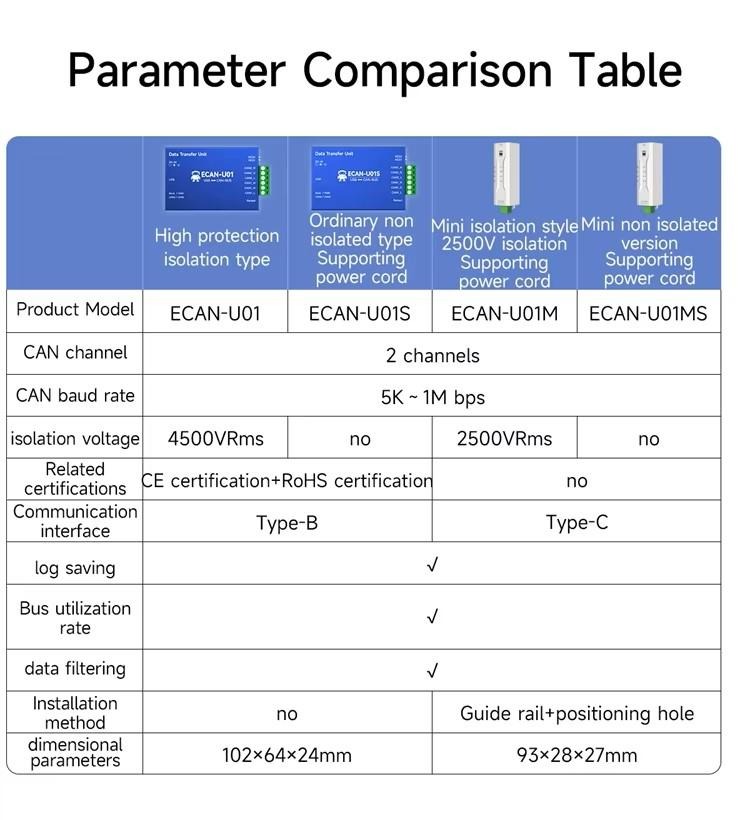
ECAN Series: An advanced CAN-to-Ethernet server. It integrates dual CAN channels with an Ethernet interface, supporting TCP/UDP protocols and electrical isolation for remote monitoring and large-scale networking.