Jeffrey Donaldson: The Story of a Unionist Leader Shaped by Family, Politics, and the Troubles

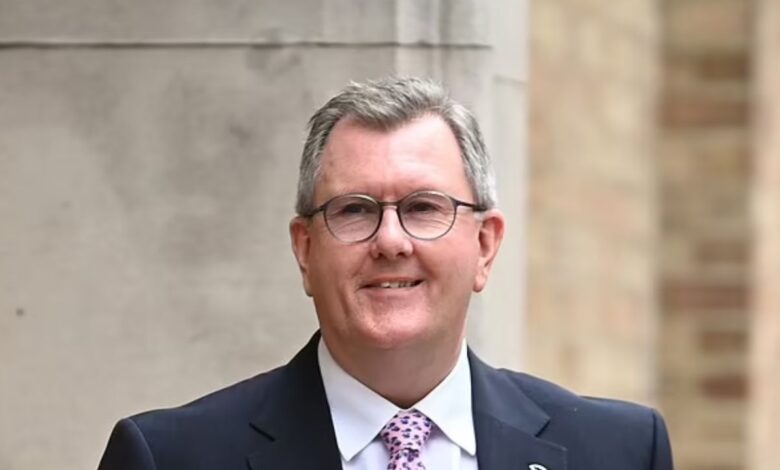
When you look at Northern Irish politics, one name shows up again and again — Jeffrey Donaldson. He has been around for decades, and his life story is filled with family tragedy, political battles, and moments that shaped the future of his country. His journey is not simple, but it is very human. And when you break it down in easy words, it becomes much clearer.
Let’s walk through it step by step, like you’re talking with a friend over a cup of tea.
Early Life: A Childhood Marked by the Troubles
Jeffrey Donaldson was born in 1962 in a small town called Kilkeel in County Down. He grew up as the oldest of eight children in a big, busy family. Life was simple, rural, and centred around home. But the Troubles were happening all around him. And when the Troubles come into your home, things change fast.
When Jeffrey was only a young boy, his cousin Samuel Donaldson, who worked as an RUC officer, was killed in an IRA bombing in 1970. Jeffrey has said before that this moment “shattered” his childhood. It wasn’t just a news story — it was family. It was personal.
Then, in 1985, another cousin, Alex Donaldson, was killed in a mortar attack on a police station. Imagine losing two close family members in such violent ways. Anyone would carry that for life. And Jeffrey did. These events became part of why he felt so strongly about unionism and why he went into politics.
Growing Up Fast: Joining Groups, Finding a Voice
As a teenager, Jeffrey Donaldson moved into adult responsibilities very early. At just 16, he joined the Orange Order, a long-standing Protestant organisation. At 18, he joined the Young Unionists, the youth wing of the Ulster Unionist Party (UUP). These steps were not just hobbies — they were life choices shaped by fear, purpose, and family history.
He also joined the Ulster Defence Regiment (UDR), a part-time unit of the British Army mostly made up of local volunteers. Jeffrey served in the Kilkeel company and rose to the rank of corporal. Members of the UDR spent long nights on patrols, at checkpoints, and guarding key points. It was not glamorous, but it was dangerous and demanding. It also made him see the conflict up close.
These choices show how early he decided what side he was on. For him, unionism wasn’t politics — it was identity. It was family. It was survival.
First Steps into Politics: A Young Voice in Stormont
By the age of 22, most people are still figuring out their jobs or finishing college. But Jeffrey Donaldson became the youngest person elected to the Northern Ireland Assembly in 1985. Imagine being 22 and suddenly walking into Stormont, meeting experienced politicians, and having to speak for thousands of people. It must have felt overwhelming — but he did it anyway.
Before that, he had already been working behind the scenes. From 1982 to 1984, he helped run election campaigns for Enoch Powell, a strong and controversial unionist figure. Later, he became a personal assistant to James Molyneaux, the UUP leader. He learned politics from the inside — how to manage campaigns, how to negotiate, how to speak in public, and how to build networks.
By 1997, he was elected to Westminster as MP for Lagan Valley, a seat he held for more than 25 years. This was the beginning of his long career in London.
A Complicated Relationship with the Good Friday Agreement
The Good Friday Agreement in 1998 was one of the biggest political moments in Northern Ireland’s history. But Jeffrey Donaldson was not on the side that supported it. He walked out of the talks on the final day because he believed the deal did not include strong enough links between Sinn Féin entering government and IRA disarmament.
To him, this wasn’t about being difficult. It was about trust. He felt the agreement did not protect the people he represented. Many people agreed with him. Many did not. But it shaped his reputation as someone who stands firm — even when it causes conflict.
A Breaking Point: Leaving the UUP
By the early 2000s, Jeffrey and David Trimble disagreed more and more. Jeffrey believed the party was moving too close to Sinn Féin. In 2003, he and two other UUP MPs resigned the party whip. Soon after, he completely left the UUP.
And in January 2004, he joined the Democratic Unionist Party (DUP) — a major turning point in his career.
Life Inside the DUP: A New Chapter Begins
When Jeffrey Donaldson joined the DUP in 2004, it changed a lot of things for him. The DUP was stronger, louder, and more hardline than the UUP at the time. So when he crossed over, some people saw it as a big move, almost like switching teams in the middle of a match. But for Jeffrey, it felt like the right home. He said he felt the DUP matched his views better.
Once he joined, he moved up the ranks quickly. He kept his seat in Westminster. He became one of the main voices in the party. And later on, he even took a role in the Northern Ireland Executive as a Junior Minister. That shows you how much trust the party had in him at the time. He was no longer just a young politician — he was a key figure.
In 2016, he was given a knighthood for his political work. The same year, he supported Brexit, which would become one of the biggest topics in his career over the next few years. Some people agreed with him. Others didn’t. But he stood firm, just as he always had.
Brexit and the Northern Ireland Protocol: A Stormy Time
After Brexit, everything changed for politics in Northern Ireland. The Northern Ireland Protocol became a huge issue. It created checks on goods between Great Britain and Northern Ireland. Many unionists felt this made Northern Ireland feel less British, and Jeffrey Donaldson was one of the strongest voices against it.
Jeffrey spoke out again and again. He said the Protocol broke the Good Friday Agreement. He said it made people feel separated from the rest of the UK. This became the main message of his leadership.
Under his direction, the DUP refused to return to power-sharing at Stormont for almost two years. It was a big move, and it put a lot of pressure on both Westminster and the EU. Some people supported the stand. Others felt it created more problems. But this was classic Jeffrey — when he believes in something, he digs his heels in.
In early 2024, a deal was finally reached with the UK government on new post-Brexit arrangements. After this, Stormont came back. It was a major moment, and Jeffrey had played a big part in getting it there.
Leadership Battles and Big Decisions
In 2021, after years of being a leading voice in Westminster, Jeffrey Donaldson ran for DUP leader. He lost the first vote to Edwin Poots by just two votes. But within a few weeks, Poots stepped down after a huge internal row. Jeffrey ran again — and this time he won without anyone running against him.
Becoming DUP leader during this period was not easy. The party was divided. Brexit was still causing problems. Stormont was unstable. And everyone was tired of the constant fights. But Jeffrey took on the job anyway, hoping he could steady the ship.
For a while, he did. He guided the party through elections, Brexit talks, and some of the hardest political days the DUP had ever seen. Many people said he was one of the most experienced leaders the party ever had.
But 2024 brought everything to a sudden stop.
The Legal Case That Shocked Northern Ireland
In March 2024, news broke that Jeffrey Donaldson had been charged with serious sexual offences from the past. The charges included rape, gross indecency, and indecent assault. His wife, Eleanor, was also charged with helping him. The story shocked Northern Ireland. Many people could not believe it.
As soon as the charges were announced, he resigned as DUP leader. The DUP suspended him. The Orange Order suspended him too. He said he was innocent and would fight the charges. But the damage to his public life was already done.
His trial is set to take place in the future, and the case continues. Until the court reaches a decision, he remains out of political life, and he has said he will not run again in any election.
It was a dramatic fall for a man who spent more than 40 years in politics.
Family, Faith, and Private Life
Away from politics, Jeffrey Donaldson has always kept parts of his life private. He is married and has two daughters. One of his daughters, Claire, is known for her strong views on women’s rights and abortion — views that are very different from Jeffrey’s own. Another daughter, Laura, works as a nurse and married into another well-known unionist family.
Jeffrey has often talked about his faith. He is a member of the Presbyterian Church. Jeffrey has also explained that he feels both Irish and British, but mainly British in terms of identity. He says there is no conflict in being both.
Legacy: How Will People Remember Him?
This is the hardest part to answer. How will Northern Ireland remember Jeffrey Donaldson?
On one side, he is seen as a long-serving MP, a strong unionist voice, and someone who stood firm during huge political changes. He played roles in Westminster, in Stormont, and in major negotiations, He helped shape the Brexit debate in Northern Ireland. He led the DUP through a messy and emotional period.
But on the other side, his career ended under a dark cloud. The charges against him are serious. They shocked the public. They changed how people see him. Even though the court has not yet reached a verdict, the damage to his political career is clear.
In the end, his story is a mix of leadership, conflict, tragedy, and controversy. It is the story of a man shaped by the Troubles, shaped by loss, and shaped by strong beliefs — but also a man whose final chapter is still unfolding.