
You’re winning tenders, your teams are on-site, and the top-line revenue looks better than it did last year. Yet, looking at the bank account at the end of the month feels like a punch in the gut. Why is the cash always so tight? This is the “Busy Fool” syndrome, a phenomenon where a business grows in size but shrinks in actual stability. In the UK construction and design sectors, many firms aren’t losing money because they lack work; they are losing it through a thousand tiny financial cuts that they haven’t learned to see. Scaling a business without a firm grip on project-level data is simply building a taller tower on a foundation of shifting sand. To break this cycle, firms are increasingly turning to specialized accounting for architects and construction professionals to move from reactive firefighting to proactive growth.
This guide isn’t about just “doing the books.” It’s about why scaling often leads to failure and how shifting your financial strategy can finally turn that high turnover into actual, spendable profit.
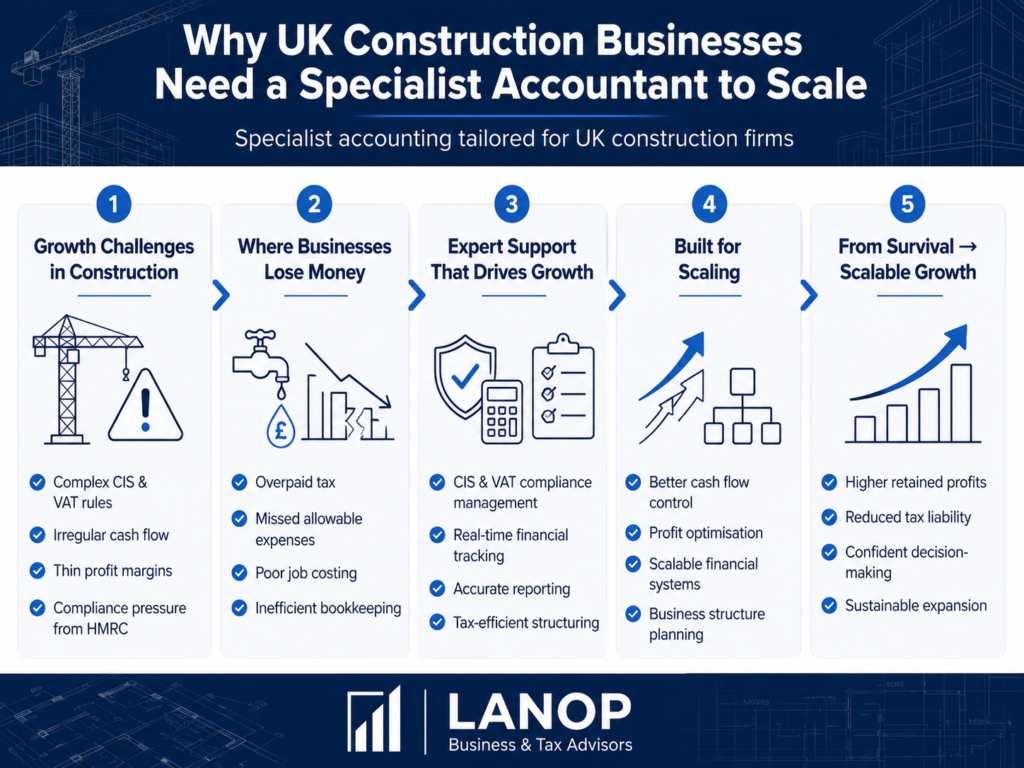
Why Construction Businesses Struggle to Scale?
Revenue is a vanity metric that hides a multitude of sins. You might be turning over five million pounds, but if your margins have slipped from 15% to 5% during the expansion, you are actually in a more dangerous position than when you were smaller.
Revenue vs. Profit: The Dangerous Trap
When you’re small, you can see every penny. As you scale, you start running multiple projects simultaneously. Suddenly, the cash from Project B is being used to pay the overdue suppliers for Project A. This “robbing Peter to pay Paul” approach creates an illusion of liquidity. You feel successful because the money is moving, but you might actually be losing money on every single brick laid.
The Fog of War
Decisions made on assumptions are the fastest way to bankruptcy. Are you estimating your labour costs based on last year’s rates or today’s market reality? Without real-time visibility into project performance, you’re essentially flying a plane with a broken altimeter. You won’t know you’re too low until you hit the ground.
Operational Complexity and Compliance
Scaling adds layers of friction. You have more subcontractors to verify, more CIS (Construction Industry Scheme) returns to file, and more complex VAT reverse charge rules to navigate. The mental load of keeping up with HMRC requirements often distracts business owners from their primary job: managing the actual build.
Why Is Construction Accounting Fundamentally Different?
Standard high-street accounting doesn’t work for this industry. If your accountant treats your business like a retail shop where you buy an item and sell it for a markup, they are doing you a disservice.
Projects as Separate Profit Centres
In construction, every project is essentially its own mini-company with its own set of risks and rewards. You need job-level tracking. If you aren’t allocating every hour of labour and every bag of cement to a specific project code, your “company-wide” profit figure is a useless average. It won’t tell you that the residential refurb is subsidizing the loss-making commercial contract.
The Lumpy Reality of Cash Flow
Payment delays and retentions are part of the architecture of this industry. Unlike a SaaS business with recurring monthly revenue, your cash flow is “lumpy.” You have massive upfront costs for materials and labour, followed by a long wait for valuations and certificates. Generic accounting methods fail to reflect this reality, leaving you with a tax bill on “accrued” profit that isn’t actually in your bank account yet.
The Hidden Cash Flow Problem
Have you ever wondered why you can be profitable on paper but unable to pay your own salary? This mismatch between profit and cash is the primary killer of growing UK firms.
The Weight of Retentions
Retention usually that last 5% of a contract held back for months can represent your entire profit margin. If your financial system doesn’t track these specifically, you might forget they exist, or worse, count them as “available cash” long before they are released.
CIS and VAT Distortions
The Construction Industry Scheme is a cash flow drain. If you are a subcontractor, having 20% or 30% of your income withheld at source puts immediate pressure on your working capital. Similarly, the VAT Domestic Reverse Charge means you no longer receive the 20% VAT “float” from your customers that many businesses once used to pay their own suppliers. Without specialized planning, these regulatory hurdles become a permanent drag on your liquidity.
What Scaling Really Requires?
Growth isn’t just about winning more work; it’s about building a system that can handle the weight of that work.
- Financial Systems Over Sales: You need a structured way to report data before you add more volume. If your spreadsheet is already messy, adding ten more rows will only make the errors ten times bigger.
- The Risk of Amplification: Scaling amplifies your existing weaknesses. If you lose £100 on a small job due to poor waste management, you’ll lose £10,000 on a major site for the same reason.
- Budget Control: Scaling requires moving from “spending what’s in the bank” to “spending what was budgeted.”
“Growth for the sake of growth is the ideology of the cancer cell.” If your margins don’t hold, the extra revenue is just extra risk.
What a Specialist Accountant Actually Does?
A specialist doesn’t just tell you what happened last year; they tell you what is happening next month. They move beyond the “compliance box-ticking” and become a strategic partner in your boardroom.
Turning Numbers Into Decisions
A good accountant provides actionable insights. They might point out that your overheads have grown faster than your gross profit, or that a specific subcontractor is consistently over-billing compared to their initial quotes. They interpret the data so you can make informed choices.
Project Profitability Tracking
By monitoring margins per project in real-time, a specialist can identify a “bleeding” job early. Perhaps the groundworks took longer than expected, or material prices spiked. Finding this out in Week 3 allows for a conversation with the client or a change in strategy; finding it out at the end of the project is just an autopsy.
Cash Flow Planning and Forecasting
They help you predict the dry spells. By mapping out when retentions are due and when major VAT payments are coming, they ensure you have the working capital to keep the lights on. They manage the “timing mismatch” that sinks so many firms.
Real-World Comparison: The Two Firms
| Feature | The Reactive Firm (General Accountant) | The Proactive Firm (Specialist Support) |
| Visibility | Finds out they lost money six months after the job. | Monitors weekly margins against budgets. |
| Strategy | Wins any work just to keep the cash flowing. | Only tenders for high-margin, “right-fit” work. |
| Stress Level | High. Always chasing the next payment. | Controlled. Cash flow is mapped months in advance. |
| Growth | Unstable. One bad job could end the business. | Sustainable. Growth is funded by actual profit. |
Why Do General Accountants Often Fall Short?
A generalist might be great at personal tax or retail accounts, but they rarely understand the “WIP” (Work in Progress) nuances of construction. They might count an invoice as income even if the valuation hasn’t been agreed upon by the client’s surveyor. This leads to overstating profit and overpaying tax.
Furthermore, generalists often miss the strategic tax opportunities unique to our industry. Are you maximizing your capital allowances on plant and machinery? Are you handling the “zero-rating” of VAT on new builds correctly? These aren’t just administrative details; they are the difference between a tax bill that helps your business and one that hurts it.
The Overlooked Challenges Architects Face
Architecture practices share many of the same “DNA” markers as construction firms, but with their own unique stressors. Like builders, architects work in phases. You might spend months on a design with very little cash coming in, only to receive a massive fee once the planning is submitted.
Unique Financial Complexity
Managing accounting for architects requires a deep understanding of phased payments and client delays. If a project is paused at the planning stage, how do you reallocate your staff costs? How do you track the profitability of a specific design phase when the work bleeds across different months? A specialist ensures that your cost allocation is as precise as your drawings, helping you understand which types of projects in the residential, commercial, or public sector are actually your most profitable.
Do You Really Need a Specialist Accountant?
If you’re a sole trader doing one kitchen extension at a time, you might manage with a simple app. But as soon as you have more than one crew or multiple design projects on the go, the complexity becomes unmanageable for a non-expert.
The real question isn’t “What does a specialist cost?” it’s “What does being an amateur cost me?” A single missed VAT claim or a project that runs 5% over budget because you weren’t watching the data can easily cost more than an entire year of professional accounting fees.
Common Mistakes That Prevent Scaling
- Ignoring Project-Level Profitability: Looking at the total bank balance instead of individual job margins.
- Poor Cash Flow Management: Assuming that an invoice sent is the same as cash received.
- Treating Accounting as Admin: Thinking of your accountant as someone who just files your taxes, rather than someone who helps you build a better business.
- Outdated Data: Making decisions in June based on accounts from the previous December.
Building a Financial System That Supports Growth
Scaling is a choice to become more professional. It requires moving from “gut feeling” to data-driven management.
- Real-Time Reporting: Use cloud-based software like Xero or Sage, integrated with project management tools. You should be able to see your financial health on your phone, not just in a thick binder.
- Forecasting: Every month, you should be looking at where you expect to be in 90 days.
- Proactive Management: If you see a cash gap coming in October, you can talk to the bank in July. Banks hate surprises; they love data.
What Should You Do Next?(Decision Framework)
- If your growth has stalled: Your visibility is likely the issue. You can’t fix what you can’t see. Focus on getting a clear dashboard of your current margins.
- If your cash flow is a rollercoaster: Prioritize forecasting. Map out your retention and major payment cycles for the next six months.
- If the complexity is making you lose sleep: It’s time for specialist support. You didn’t start an architecture or construction firm to spend your weekends reconciling bank statements.
Frequently Asked Questions
Why do UK construction businesses need a specialist accountant rather than a general one?
Construction businesses operate under a complex framework involving CIS, VAT Domestic Reverse Charge, and project-based cash flow that a general accountant rarely handles. A specialist proactively identifies tax-saving opportunities and compliance risks that a generalist would simply overlook. For a construction business looking to scale, this knowledge is not a luxury.it is a necessity. Getting the right expertise from the start saves significantly more than it costs.
How does a specialist accountant help construction businesses manage cash flow while scaling?
Scaling without tight cash flow management is one of the fastest routes to insolvency even when the order book is full. A specialist builds detailed forecasts accounting for CIS deductions, delayed payments, retention releases, and VAT timing differences. They identify cash flow gaps well in advance and recommend practical solutions before shortfalls become critical. This forward-looking oversight gives owners the confidence to take on bigger contracts without overextending.
How can a specialist accountant help construction firms win larger contracts?
Winning larger contracts requires audited accounts, demonstrated financial stability, and meeting bonding thresholds that smaller firms often struggle to satisfy. A specialist ensures your financial statements are accurate and present your business in the strongest possible light to procurement teams. They also advise on financial structuring needed to qualify for public sector tenders and framework agreements. Clean, well-presented financials can be the difference between winning and losing a major contract.
What role does a specialist accountant play in managing CIS compliance as a business grows?
As construction business scales, CIS obligations become significantly more complex managing multiple subcontractors, verifying status, and submitting monthly returns all require dedicated expertise. A specialist manages the entire CIS compliance process ensuring deductions are correct and returns submitted on time. They also help growing businesses apply for gross payment status, dramatically improving cash flow by eliminating deductions at source. Getting CIS wrong at scale attracts heavy HMRC penalties that seriously damage finances and reputation.
How does a specialist accountant support construction businesses through rapid growth?
Rapid growth brings unique challenges: more subcontractors, larger material costs, increased VAT complexity, and maintaining profitability across multiple simultaneous projects. A specialist implements the financial systems and controls needed to keep pace with growth without losing visibility over your numbers. They ensure your business structure remains tax-efficient as turnover increases and help plan for working capital that larger projects demand. With the right support, growth becomes a managed process rather than a financial gamble.
From Growth to Sustainable Scale
Growth is an appetite, but scale is a discipline. Most firms in the UK fail not because they weren’t good at what they did, but because they grew beyond their ability to control their finances.
Shifting from reactive accounting to strategic financial management is the only way to ensure your business survives the transition from a small outfit to a major player. That is where Lanop Business & Tax Advisors come in. From managing CIS compliance and VAT obligations to structuring profit extraction and improving cash flow, their experienced team handles every dimension of your construction finances keeping you compliant, reducing your tax burden, and ensuring your business is always ready for the next level.
By partnering with Lanop Business & Tax Advisors, you aren’t just staying compliant, you are building a machine that produces profit as consistently as you produce quality buildings. Transparency is your most powerful tool. Use it to build something that lasts.