Your toothbrush is the most personal wellness tool you own — and yet most of us still reach for something that hasn’t evolved in decades. That’s changing fast. The rise of the smart electric toothbrush has transformed a mundane two-minute chore into a precision-guided oral health ritual, one that dentists are increasingly recommending and health-conscious consumers are enthusiastically embracing.
But with dozens of options flooding the market, choosing the right one can feel overwhelming. In this comprehensive guide, we’ll break down everything you need to know — from how these devices work to what actually matters when you’re making a purchase decision — so you can invest wisely in your oral health.
Why Regular Toothbrushes Simply Can’t Compete
Let’s start with a hard truth: manual brushing, even when done correctly, leaves a significant amount of plaque behind. Studies show that the average person brushes for only 45 seconds — far short of the dentist-recommended two minutes — and applies inconsistent pressure that can either miss plaque-heavy zones or, worse, erode enamel and damage gum tissue over time.
A smart electric toothbrush solves these problems systematically. Where a manual brush relies entirely on your technique and discipline, an electric model automates the mechanical work — oscillating, pulsating, or vibrating at frequencies your wrist could never match — while embedded sensors and app connectivity guide you toward better habits in real time.
The American Dental Association has recognized powered toothbrushes as significantly more effective at reducing gingivitis and plaque compared to manual alternatives. And when you layer AI-driven personalization and pressure intelligence on top, the gap widens even further.
What Makes a Toothbrush “Smart”?
Not every electric toothbrush qualifies as “smart.” The distinction lies in the intelligence layer — the features that go beyond simply spinning a brush head and actively respond to how you’re brushing. Here’s what separates a truly smart device from a basic powered brush:
• Pressure Sensors: These detect when you’re brushing too hard and either alert you (via vibration or LED indicators) or automatically reduce motor speed to protect your gum line and enamel.
• Quadrant Timers: Built-in timers ensure you spend equal time on each section of your mouth, eliminating the all-too-common habit of over-brushing one area and neglecting others.
• Multiple Cleaning Modes: From sensitive mode for post-treatment care to deep cleaning for heavy stain removal, smart brushes let you match the intensity to your current needs.
• App Connectivity: Bluetooth-paired apps track your brushing duration, coverage, pressure patterns, and even remind you when it’s time to replace your brush head.
• Advanced Oscillation Technology: The best smart brushes use sophisticated motion profiles — combining rotation with oscillation or sonic vibration — to dislodge plaque from interdental spaces that neither floss nor manual brushing typically reaches.
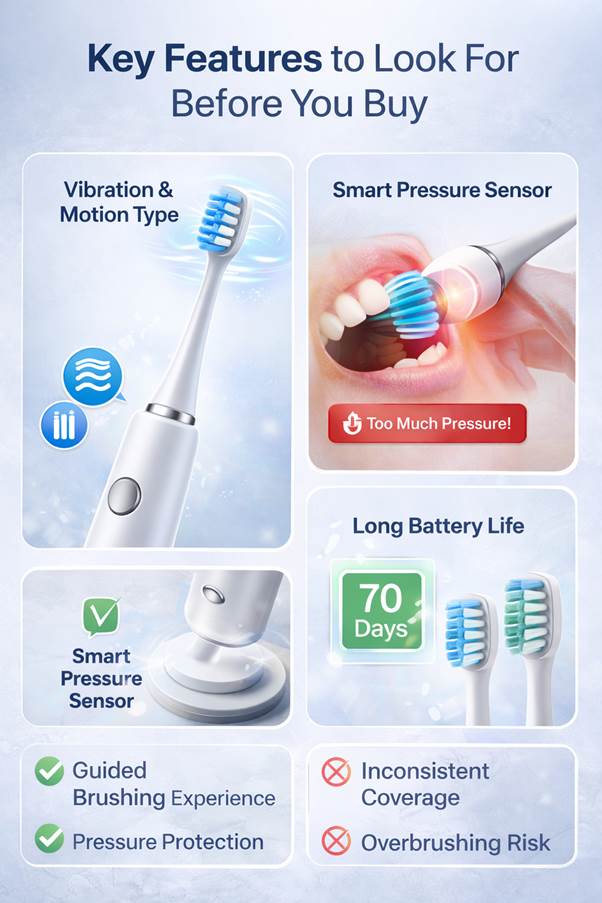
Key Features to Look For Before You Buy
Shopping for a smart electric toothbrush involves balancing several factors. Price alone doesn’t tell the story — a $300 brush with the wrong features for your needs is a worse investment than a thoughtfully engineered $100 model. Here’s your essential buying checklist:
1. Vibration Frequency and Motion Type
Higher vibrations per minute (VPM) don’t automatically mean better cleaning — the motion type matters enormously. Sonic brushes (10,000–40,000 strokes/min) use high-speed side-to-side motion to create hydrodynamic fluid movement that reaches between teeth. Oscillating-rotating brushes use a more mechanical circular motion. And a new generation of devices now combines oscillation with high-frequency vibration — a dentist-inspired approach that delivers the best of both worlds.
2. Intelligent Pressure Sensing
This is non-negotiable if you care about long-term gum health. Brushing too hard is one of the leading causes of gum recession and enamel erosion. A quality pressure sensor doesn’t just warn you — it actively reduces motor intensity to prevent damage in real time. Look for this feature as a priority, not a luxury.
3. Battery Life
Frequent charging is one of the most cited frustrations among electric toothbrush users. A brush that needs charging every 7–10 days becomes a hassle when traveling or when daily routines are disrupted. Premium models now offer 60–90 days per charge — a genuine quality-of-life upgrade that’s worth seeking out.
4. Brush Head Design
The head is where the cleaning actually happens. Look for soft-medium bristle ratings, TPE (thermoplastic elastomer) coatings for gentle interdental cleaning, and tapered tip designs that reach back molars. The best replacement heads are available in multiple variants — whitening, sensitive, gum care — so you can adapt your brush to your current dental situation.
5. App Ecosystem and Personalization
Connectivity is a nice-to-have for some users and essential for others. If you’re recovering from gum disease, whitening, or orthodontic treatment, a companion app that gives you real-time coaching and long-term tracking can be genuinely transformative. Look for apps that offer custom mode creation and dental professional integrations.
The Science Behind Superior Cleaning
It’s worth pausing on the science, because understanding why these devices outperform manual brushing helps you make a smarter purchase — and use your brush more effectively.
Plaque is a biofilm — a sticky, structured colony of bacteria that adheres to tooth surfaces. Dislodging it requires both mechanical disruption (physical bristle contact) and fluid dynamics (the turbulence created by rapid bristle movement that carries debris away). Sonic and oscillating-rotating technologies both excel at the mechanical disruption, but the most advanced brushes now engineer their oscillation angle specifically to maximize contact between bristle tips and the gum line — precisely where gum disease begins.
Clinical data consistently shows that electric toothbrushes reduce plaque by 21% and gingivitis by 11% more than manual brushing after three months of use. Among smart electric models with pressure sensors, gum health outcomes improve further — largely because users are prevented from causing the micro-trauma that leads to recession.
Spotlight: A Standout Option Worth Considering
Among the current crop of premium options, the Laifen Wave Pro deserves particular attention for users who want professional-grade performance without a professional-grade price tag. Built on proprietary WaveMotion Technology, it combines a 60° oscillation angle with an extraordinary 66,000 vibrations per minute — a specification that mirrors the motion profile used in professional dental tools.
If you’re ready to experience what a genuinely next-generation smart electric toothbrush feels like in practice, the Laifen Wave Pro is one of the most compelling options available today — offering an intelligent pressure sensor that both alerts you and automatically adjusts speed, two cleaning modes (Daily and Deep) with three intensity levels each, TPE-coated brush heads engineered for safe interdental cleaning, a 70-day battery life on a single wireless charge, and companion app support for fully personalized settings. It’s available from $99.99 — a remarkable value proposition for this level of engineering.
Common Mistakes People Make With Electric Toothbrushes
Even the best brush underperforms if used incorrectly. Here are the habits that undermine your results:
• Scrubbing instead of guiding: Let the brush do the work. Your job is to slowly guide the head from tooth to tooth — the motor handles the actual cleaning motion.
• Skipping the gum line: Angle the brush head at 45 degrees toward the gum line, where plaque accumulation begins. Most people brush the visible tooth surface and miss this critical zone.
• Not replacing brush heads: Bristles wear and lose effectiveness after 2–3 months. Most smart brushes remind you when it’s time — listen to those reminders.
• Rushing: Even with a quadrant timer, some users override the beeps. Trust the system and let each quadrant get its full 30 seconds.
• Neglecting the tongue and palate: Bacteria don’t stop at the teeth. A quick pass across your tongue at the end of each session makes a measurable difference in overall oral health.
Who Benefits Most From Making the Switch?
While smart electric toothbrushes benefit virtually everyone, certain groups see the most dramatic improvements:
• People with gum disease or sensitivity: The combination of gentle TPE bristles, adjustable intensity, and real-time pressure feedback makes these brushes far safer than manual brushing for inflamed or receding gums.
• Orthodontic patients: Braces create plaque traps that are nearly impossible to clean manually. The pulsating and fluid dynamics of electric brushes reach areas wires and brackets obstruct.
• Busy professionals and frequent travelers: Long battery life (30–90 days) means you can pack the brush without packing the charger. Wireless charging further reduces friction.
• People focused on whitening: Consistent plaque removal is the most underrated whitening strategy. Over months, the difference in surface staining between electric and manual brush users becomes visible.
• Children and teenagers: Teens are notoriously inconsistent brushers. A brush with a timer, app gamification, and automatic pressure protection takes human error largely out of the equation.
Maximizing Your Investment: Tips for Long-Term Results
Getting the most from a smart electric toothbrush is less about technique and more about consistency. Here’s how to build a routine that compounds over time:
• Brush twice daily, every day — morning and night. The morning session removes overnight bacterial growth; the evening session removes the day’s accumulated plaque before it mineralizes into tartar.
• Use the app’s progress tracking to identify which quadrant you consistently under-clean, and consciously correct it.
• Pair your brushing habit with flossing or a water flosser. Electric toothbrushes significantly improve interdental access, but they don’t replace flossing.
• Talk to your dentist about your data. Some apps allow you to share brushing analytics with dental professionals, enabling more targeted treatment and advice.
• Take advantage of multiple modes. Use sensitive mode post-cleaning appointments or after whitening treatments; switch to deep clean mode before social events when you want your smile at its brightest.
The Bottom Line: Your Smile Is Worth the Upgrade
The case for switching to a smart electric toothbrush has never been stronger. The technology has matured to the point where the gap between budget and premium models is mostly about features and materials — not fundamental effectiveness. Even entry-level smart brushes deliver meaningfully better plaque removal, gum protection, and habit formation than manual brushing.
What you’re really investing in isn’t a toothbrush — it’s a preventative health tool. Every dollar spent on better oral hygiene technology returns multiples in avoided dental treatments, maintained tooth structure, and the quiet confidence of a genuinely healthy smile.
Whether your priority is gum health, whitening, travel convenience, or simply leveling up a habit you’ve had on autopilot for years — there’s a smart electric toothbrush engineered precisely for your needs. The research is clear, the technology is proven, and the upgrade path is more accessible than ever.
Your dentist’s next visit will tell the story. Start brushing smarter today.