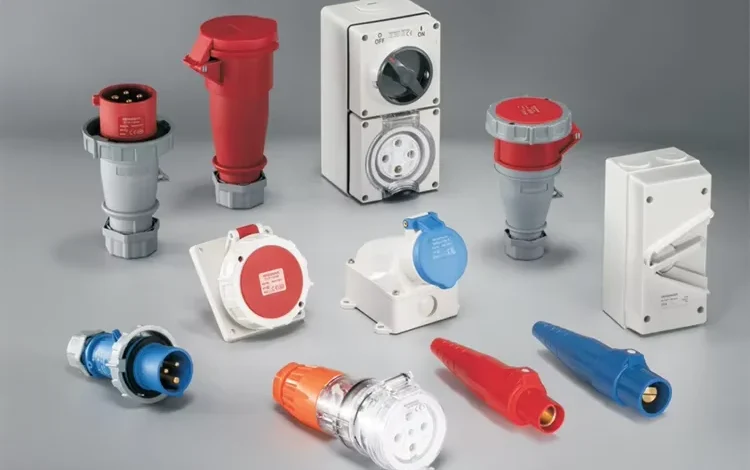
In the UK’s demanding industrial landscape, electrical connectors are very much “unsung heroes” helping to ensure the highest standards of safety and efficiency.
Various types of industrial electrical connectors exist, encompassing the likes of industrial plugs and sockets, cable couplers, and appliance connectors.
The key thing that unites all these types, however, is that they are heavy-duty electromechanical devices designed to securely join electrical circuits. This, in turn, allows for the dependable transmission of power, data, and signals in harsh environments.
What Differentiates Industrial Electrical Connectors from Standard Domestic Plugs?
We’re sure that if you’re reading this in the UK, you will be familiar with the three-pin type of plug found in homes up and down the country.
These common domestic plugs adhere to BS 1363, the British Standard for 13-amp fused plugs, socket-outlets, adaptors, and connection units.
The big distinction between these domestic plugs and industrial electrical connectors, is the need for the latter to handle higher currents, voltages, and tough conditions such as dust, water, vibration, chemicals, and mechanical stress.
An Introduction to IEC 60309 Connectors
In light of the above, it shouldn’t surprise you to read that the vast majority of industrial electrical connectors follow a different standard to BS 1363.
Specifically, these components comply with the international standard IEC 60309 (adopted as BS EN 60309 in Britain, previously known as BS 4343 or “CEE form”).
These devices are often referred to as “Commando” plugs/sockets, CEE plugs, or simply “industrial” plugs and sockets.
The use of these components is vital for ensuring compatibility, preventing dangerous mismatches, and adhering to UK electrical regulations (including the Electricity at Work Regulations 1989 and BS 7671 Wiring Regulations).
The Typical Characteristics of Industrial Electrical Connectors
By enabling secure connections for power and control signals, industrial connectors go a long way to minimising downtime and enhancing maintenance efficiency.
However, to achieve such impressive results, these devices need to have certain features and qualities:
- Durable Designs
Industrial connectors largely distinguish themselves from their standard domestic counterparts through their rugged, high-impact, and often waterproof or flame-retardant housings.
These properties allow industrial connectors to deliver consistent performance even in extreme conditions.
- Locking Mechanisms
These devices also frequently utilise screw-locking, bayonet, or twist-lock systems to guard against accidental disconnection.
- Colour Coding for Voltage
To prevent dangerous cross-connections, industrial electrical connectors adhere to a strict colour and “clock-position” keying system.
For example, yellow (110V) connectors are typically used on construction sites for portable power tools. This compares to blue (230V) connectors, which are standard for single-phase supplies in commercial and light industrial environments.
Red (400V to 415V) connectors, on the other hand, are customarily used for three-phase machinery and heavy industrial equipment.
- Ingress Protection (IP) Ratings
Defined under the BS EN 60529 standard, IP ratings point to a connector’s effectiveness at resisting dust and water.
For instance, a connector with an IP44 (splash-proof) rating is suitable for use in sheltered outdoor areas or indoor spaces with light moisture.
If, however, a given industrial connector is to be safely used in wash-down areas or heavy rain, the component must have a rating of IP67/IP68 (watertight).
Common Types of Industrial Electrical Connectors
Professionals who may have reason to use industrial electrical connectors need to be familiar with such widely used types as:
- Pin and sleeve (CEE) connectors, the standard “Commando” style for high-current power distribution
- Circular connectors, which are popular for their ease of mating, and see use in harsh environments such as aerospace and the military
- Rectangular/heavy-duty (HDC) connectors, which are favoured for modular machinery involving the housing of multiple signals and power lines in a single rugged casing
- Sensor/automation (M12/M8) connectors, which are modular, threaded components used in factory automation and robotics.
Industrial Electrical Connectors Fulfil a Range of Vital Functions
All in all, with their applications across such fields as construction, manufacturing, agriculture, utilities, and others, industrial electrical connectors play an imperative role in all manner of specialised applications.
These components offer a reliable and quick connect/disconnect alternative to the permanent hardwiring of machinery, automation systems, and infrastructure.